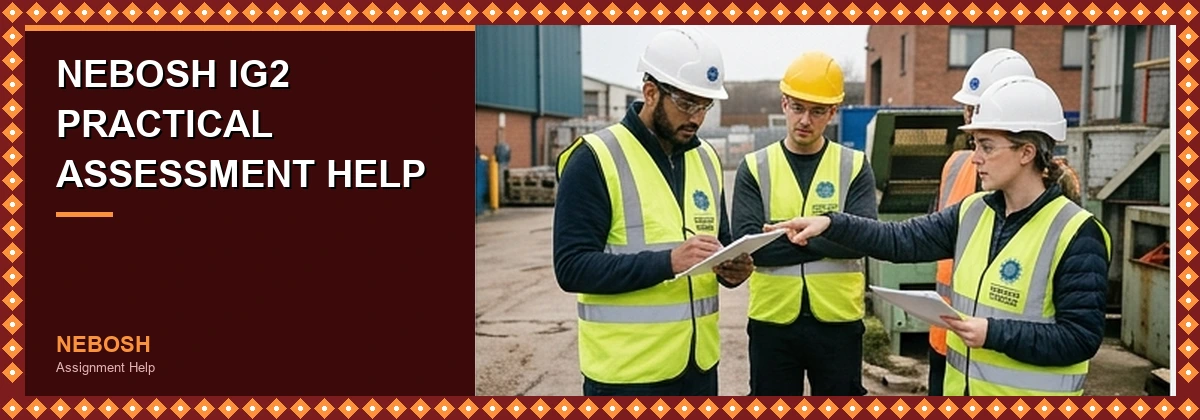
What Does the NEBOSH IG2 Practical Assessment Require?
The NEBOSH IG2 requires candidates to conduct a real-world workplace health and safety assessment and produce a structured written report in three parts. These three components are assessed together and must all be present for the submission to be marked.
Component 1 — Workplace Observation. The candidate describes the workplace assessed: its industry sector, physical layout, workforce size, the activities carried out, and the significant hazards identified during the site visit. This is not a desk-based exercise — NEBOSH requires the student to physically visit the workplace, observe conditions, and document what they see. Photographs are permitted and recommended.
Component 2 — Risk Assessment. The candidate produces a formal risk assessment of the identified hazards, using a consistent risk rating system applied across all entries. NEBOSH's minimum expectation is five fully assessed hazard entries, but examiner guidance and marking criteria consistently indicate that eight to ten complete entries are required for distinction-level depth. Each hazard entry must include all mandatory fields — incomplete entries do not earn full marks even if the hazard is correctly identified.
Component 3 — Management Report. The candidate writes a prioritised set of recommendations for the workplace, explaining the rational for each recommendation and connecting it to the risk rating from the assessment. This is the component most often identified by examiners as the differentiator between pass and distinction. Generic recommendations not linked to specific risk data consistently score lower than SMART, justified, risk-score-referenced recommendations.
All three components must be submitted together. Students conduct the assessment in a real workplace — their own employer's site, a family member's or colleague's workplace, or a site accessible through a NEBOSH training provider.
NEBOSH IG2 Workplace Inspection: What to Observe and How to Record It
Systematic observation identifies the hazards that form the basis of the IG2 risk assessment. Candidates who approach the inspection without a structured methodology typically observe only the most obvious hazards and miss the breadth required for distinction-level submissions.
NEBOSH expects candidates to observe and record hazards across five recognised categories:
1. Physical hazards — working at height (unguarded mezzanine edges, fragile roofs, unsecured ladders), moving machinery (unguarded nip points, rotating parts), manual handling (heavy loads, awkward postures, repetitive tasks), slips and trips (contaminated floors, trailing cables, uneven surfaces), and vehicle movements (forklift traffic, delivery bay pedestrian/vehicle conflict).
2. Chemical hazards — substances regulated under COSHH (Control of Substances Hazardous to Health Regulations 2002), including cleaning products, lubricants, adhesives, process chemicals, and welding fumes. Each chemical hazard entry should note the substance, its COSHH classification, the route of entry (inhalation, skin contact, ingestion), and who is exposed.
3. Biological hazards — Legionella risk in water systems (cooling towers, hot water storage, spa baths), bloodborne pathogen risk in healthcare or first aid settings, and mould or organic dust exposure in food processing or agricultural environments.
4. Ergonomic hazards — workstation design (VDU workstations not assessed under DSE Regulations 1992 requirements, non-adjustable seating), repetitive strain risk from assembly tasks, and awkward posture risk from poorly positioned work surfaces or storage.
5. Psychological hazards — work-related stress indicators (excessive workload, lone working without adequate support, high-pressure shift environments), and bullying or harassment risk factors observable at the management level.
Documentation method. NEBOSH recommends a structured observation form — a systematic checklist that prompts the candidate to consider each hazard category in each area of the workplace. Record each observation with: area of workplace, activity observed, hazard identified, who is affected, and any existing controls already in place.
Photographs. Label each photograph with the hazard identified, the location in the workplace, and the number of people potentially affected. Photographs support the written observation and demonstrate that the candidate physically attended the site.
Examiner reports note that candidates who observe only one or two hazard categories — typically physical hazards only — receive lower marks than those who systematically cover all five categories.
See NEBOSH IGC assignment support for broader guidance on the full IGC qualification including IG1.
NEBOSH IG2 Risk Assessment Format: What Examiners Expect
The IG2 risk assessment is a formal document with required fields per hazard entry. A distinction-level risk assessment entry demonstrates all mandatory fields completed accurately, a consistent risk rating system applied, and controls referenced to the hierarchy of controls framework and relevant legislation.
Mandatory fields per hazard entry:
| Field | What to Include |
|---|---|
| Hazard description | Specific hazard, not a category (e.g., "unguarded trailing cable across pedestrian route to emergency exit" not "trip hazard") |
| Who is at risk | Named group from the workplace + estimated number |
| Existing controls | Controls already in place at the time of inspection |
| Likelihood rating | Score 1–5 (1 = very unlikely; 5 = almost certain) |
| Severity rating | Score 1–5 (1 = negligible; 5 = catastrophic/fatal) |
| Risk score | Likelihood × Severity = Risk Score (1–25) |
| Additional controls recommended | Specific additional actions required |
| Residual risk score | Risk score after recommended controls are implemented |
The "suitable and sufficient" standard. Regulation 3 of the Management of Health and Safety at Work Regulations 1999 requires employers to undertake risk assessments that are suitable and sufficient — meaning they identify all significant risks relevant to the activities being carried out, not every conceivable hazard in existence. Examiners apply this standard: a risk assessment that misses significant hazards present in the described workplace is not suitable and sufficient.
Hierarchy of controls. Recommendations must follow the hierarchy: Elimination → Substitution → Engineering controls → Administrative controls → PPE. Recommendations that default to PPE without considering higher-order controls lose marks. Distinction-level entries name the specific legislation relevant to each hazard — for example, Working at Height Regulations 2005 Regulation 6 for height work, COSHH Regulations 2002 Regulation 7 for chemical hazards.
Justification depth. Examiner reports consistently note that students who list controls without justifying why each control reduces the specific risk identified score lower than those who connect each control to the mechanism of harm. "Install guardrails on the mezzanine edge" earns a mark; "Install guardrails at 1,100mm height and 500mm intermediate rail height on the mezzanine edge, as required by the Workplace (Health, Safety and Welfare) Regulations 1992 Regulation 13, to prevent falls from the 3.5m height differential — this reduces the severity score from 5 to 2 and the risk score from 20 to 8" earns multiple marks.
IG2 Management Report: How to Write Recommendations That Score Marks
The management report prioritises recommendations by risk score and justifies each one against the data from the risk assessment. This is the component of the IG2 where distinction is most reliably won or lost, because it tests the candidate's ability to think and communicate as a health and safety professional rather than simply completing a form.
Report structure:
- Executive summary — brief overview of the workplace assessed, the number of hazards identified, and the overall risk profile
- Prioritised recommendations — ordered from highest to lowest risk score, each recommendation accompanied by full justification
- Implementation timeline — realistic timeframe for each recommendation (SMART format)
- Resource implications — brief acknowledgement of the cost and resource required for each recommendation
SMART recommendation format. Examiners consistently reward recommendations framed with specificity, measurability, achievability, relevance, and time-bound implementation. The difference between a pass-level recommendation and a distinction-level recommendation is visible at the sentence level:
Pass-level: "Improve guarding on machinery."
Distinction-level: "Install fixed interlocked guarding conforming to BS EN ISO 14120:2015 on the unguarded nip point of the packaging line conveyor (Hazard 3, current risk score 20), to be completed by [date 30 days from inspection] by the maintenance supervisor. This control is required under PUWER 1998 Regulation 11 and will reduce the risk score from 20 to 6 by eliminating direct access to the dangerous part."
The distinction-level recommendation names the specific hazard (cross-referenced to the risk assessment), names the responsible person, gives a timeframe, names the relevant legislation, and states the quantified risk reduction.
Cost-benefit framing. Distinction-level management reports acknowledge the cost of implementing each recommendation and justify it against the potential cost of harm. The HSE publishes average injury cost data — an average non-fatal workplace injury costs employers approximately £8,700 in lost production, investigation time, and absence management. A recommendation to install £400 of guardrailing to prevent a risk-score-20 falls hazard is readily justified on cost-benefit grounds and examiners reward this level of financial reasoning.
Linking recommendations to legislation. Each recommendation should reference the legal duty that requires or supports it. This demonstrates to the examiner that the candidate understands not just what good practice looks like but why it is a legal requirement — the distinction between describing what should be done and explaining why it is required.
How Does the NEBOSH IG2 Connect Workplace Hazard Identification to Health and Safety Management Principles?
The IG2 is not a compliance checklist exercise. It tests whether the candidate understands why systematic hazard identification and risk control matters within a management system context. NEBOSH's management system framework — drawing on HSG65 and the Plan-Do-Check-Act cycle — expects that a competent health and safety professional approaches a workplace inspection with an organised methodology, identifies hazards systematically across all categories, assesses risk using a consistent and defensible system, and recommends controls that address the risk in order of effectiveness.
Students who treat the IG2 as a form-filling exercise — identifying only obvious hazards, applying risk ratings without consistent criteria, and writing generic recommendations — consistently score in the pass to merit range. Students who approach the IG2 as the demonstration of professional competency it is designed to test — systematically covering all five hazard categories, applying a consistent Likelihood × Severity matrix, and writing SMART management recommendations with legislation references and risk score justification — consistently score at distinction level.
Common Reasons NEBOSH IG2 Practical Assessments Are Referred
The five most common IG2 referral causes — drawn from NEBOSH examiner report patterns and marking guidance — are each preventable with careful preparation.
1. Risk assessment entries missing mandatory fields. The most common cause of IG2 referral is submission of risk assessment entries with incomplete fields — particularly missing "who is at risk" detail, absent likelihood or severity ratings, or missing residual risk scores after recommended controls. Every field in every entry must be completed.
2. Management report recommendations not prioritised by risk score. Recommendations presented in the order the hazards were observed rather than in risk-score order do not demonstrate the professional judgement the management report component tests. Highest risk score hazards must be addressed first.
3. Too few hazards identified. Submissions with fewer than five complete hazard entries consistently receive a referral. For distinction, eight to ten entries covering all five hazard categories is the expected minimum.
4. Recommendations too generic. "Improve training," "provide PPE," and "review procedures" are generic recommendations that earn minimal marks regardless of how many are listed. Each recommendation must be specific to the hazard identified, cross-referenced to the risk assessment data, and framed in SMART format.
5. Missing management report section entirely. Submitting only the workplace observation and risk assessment without the management report results in an automatic referral. All three components must be present.
See NEBOSH assignment referral guidance for information on the re-submission process and NEBOSH assignment marking criteria for the grading band definitions that apply to IG2.
How to Choose a Suitable Workplace for the NEBOSH IG2 Inspection
NEBOSH accepts any real workplace for the IG2 practical assessment — students may use their own employer's site, a family member's or colleague's workplace, or a site provided through their NEBOSH training provider. The choice of workplace significantly affects how easy or difficult it is to achieve a high-depth submission.
Workplaces with clear, varied physical activity — warehousing, manufacturing, construction sites, hospitality kitchens, and care homes — provide natural hazard diversity across multiple categories. These environments produce risk assessment submissions with sufficient breadth to cover all five hazard categories, which is required for distinction-level marking.
Office environments can be used and have been accepted by NEBOSH, but they present a practical challenge: most observable hazards in a standard office fall into two categories (ergonomic and fire), making it more difficult to demonstrate the breadth of hazard identification that distinction-level submissions require. Students using office workplaces should extend the scope of their inspection to include areas adjacent to the main office — server rooms, kitchen facilities, delivery areas — to increase hazard category coverage.
What to confirm before committing to a workplace:
- Physical site access for the inspection visit (with documented permission)
- Minimum two to three distinct work areas to inspect
- At least three of the five hazard categories present in observable form
- Ability to photograph hazards for inclusion in the submission
See NEBOSH IGC assignment help for guidance on the full IGC qualification and IG1 preparation.
FAQ — IG2 Practical Assessment Representative Questions
Can I do the NEBOSH IG2 at my own workplace?
Yes. NEBOSH permits students to use their own employer's workplace for the IG2 practical assessment, provided the site has sufficient hazard diversity to complete a meaningful risk assessment covering multiple hazard categories. Students must conduct the assessment themselves — they cannot use a pre-existing company risk assessment or submit their employer's documented risk assessments as their own work.
How many hazards do I need for the NEBOSH IG2 risk assessment?
NEBOSH does not specify a minimum number in published guidance, but examiner reports and marking guidance consistently indicate that eight to ten fully assessed hazard entries — with all mandatory fields completed — are required for distinction-level submissions. Fewer than five complete entries typically results in a refer.
How long does the NEBOSH IG2 take to complete?
The physical site visit and observation typically takes 2–4 hours for a thorough inspection covering all five hazard categories. Completing the risk assessment document and management report to distinction standard takes most students 8–16 hours total. The IG2 must be submitted within the timeframe set by the approved learning provider — typically within the programme enrolment period.
Does the NEBOSH IG2 need to be typed or handwritten?
NEBOSH accepts both typed and handwritten submissions, but typed submissions are strongly recommended for readability and presentation. NEBOSH provides a standard IG2 template document that must be used — students cannot create their own format. The completed document is submitted electronically via the NEBOSH portal or through the approved learning provider.
Can I use a risk assessment template from my workplace for the NEBOSH IG2?
No. NEBOSH requires students to use the official IG2 assessment template. However, students may use their workplace's hazard categories and known conditions as the basis for their own original assessment entries within the NEBOSH template — as long as the content represents the student's own analysis of the site, not a copied company document.
Common Questions
Is this service specific to NEBOSH qualifications?
Yes. We specialise exclusively in NEBOSH (National Examination Board in Occupational Safety and Health) qualifications. Our writers are selected for their specific knowledge of NEBOSH units, marking criteria, and grade descriptors — not generic academic writing.
Will my assignment be plagiarism free?
Every assignment is written from scratch and run through Turnitin before delivery. You receive a copy of the originality report alongside your completed work.
How quickly can you complete my assignment?
Standard turnaround is 5–7 days. For urgent OBE orders we offer 24-hour and 48-hour expedited delivery at an additional cost. Contact us to confirm availability for your deadline.
What if I'm not happy with the work?
We offer unlimited free revisions within 14 days of delivery. If we cannot meet your requirements after multiple revisions, we offer a full refund — no questions asked.